
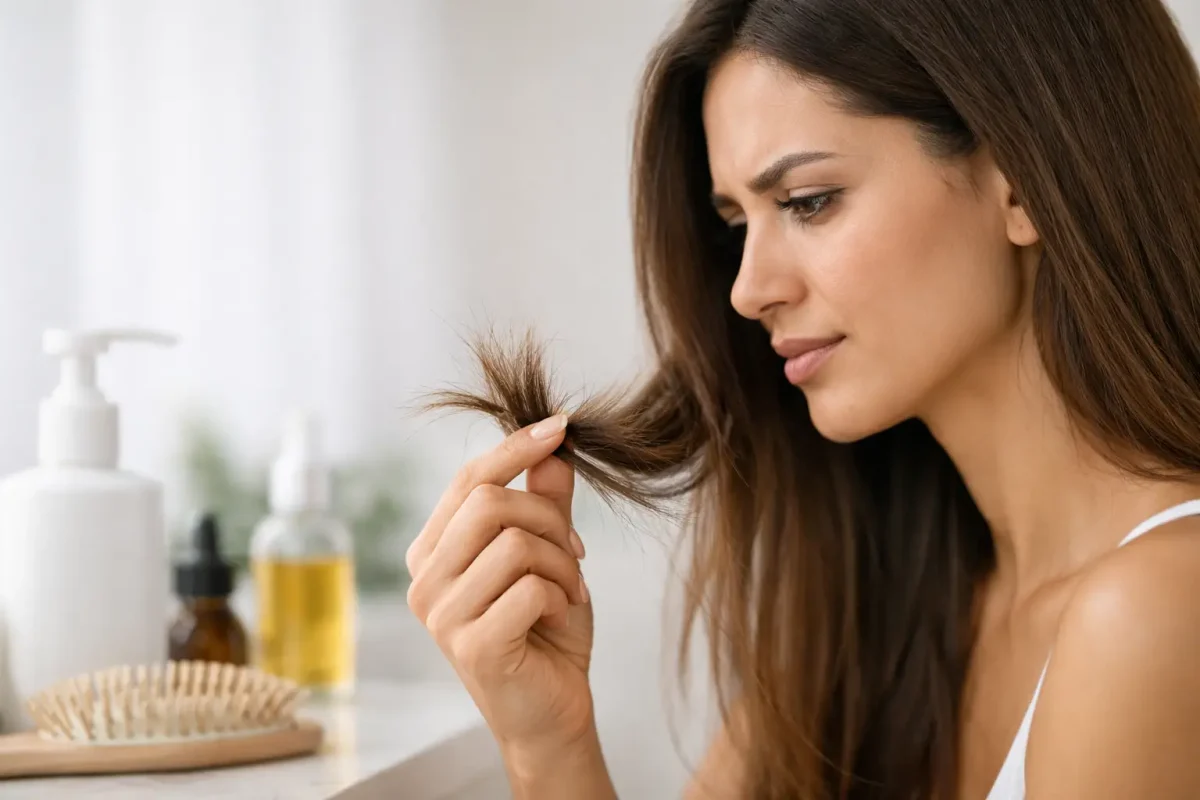
Breakage usually shows up before most people realize what they are seeing. Your ponytail feels thinner, the ends look fuzzy instead of clean, and little snapped pieces stick out around the crown no matter how carefully you style them. If you are wondering how to fix hair breakage, the answer is rarely one miracle product. It comes down to figuring out what is stressing the hair, stopping that cycle, and giving your strands the right kind of support.
Hair breakage is different from shedding. Shedding happens at the root as part of the normal hair growth cycle. Breakage happens along the hair shaft, which means the strand has become weak enough to snap. That distinction matters, because hair that is breaking needs a different response than hair that is simply falling out naturally.
What hair breakage actually looks like
Broken hair tends to feel rough, uneven, and dry through the mid-lengths and ends. You might notice split ends, white dots on strands, shorter pieces around the hairline, or a style that suddenly looks frizzy even after smoothing products. Hair can also lose shine because the cuticle is no longer lying flat.
In the salon, breakage often has more than one cause. Heat styling might be part of it, but so can over-lightening, rough brushing, tight hairstyles, skipped trims, hard water, or using products that are too harsh for your hair type. That is why a real fix starts with the pattern, not just the symptom.
How to fix hair breakage by finding the cause
The fastest way to waste money on hair care is to treat all damage the same. Fine hair that is breaking from hot tools needs a different approach than curly hair that is snapping from dryness, or lightened hair that has been pushed too far chemically.
Start by looking at your last few months of hair habits. If you bleach, lighten, tone, or use high-lift color regularly, chemical stress may be the main issue. If you flat iron every day or blow-dry on maximum heat, thermal damage is probably involved. If your hair is healthiest near the roots and weakest at the ends, that points to cumulative wear and tear. If breakage is concentrated around the temples or nape, tension from styling could be the culprit.
This part matters because once a strand is split or snapped, it cannot be truly repaired back to brand-new condition. Products can patch, smooth, and strengthen the feel of the hair, but the long-term fix is preventing more damage while trimming away the worst areas over time.
Start with less stress, not more product
When hair is fragile, piling on more products is not always better. A simpler routine often works best while the hair recovers.
Use a gentle shampoo that cleans without stripping everything out of the hair. If your scalp gets oily, you still need proper cleansing, but avoid scrubbing the lengths aggressively. Focus shampoo at the scalp and let the suds rinse through the ends. Follow with a conditioner that gives slip and softness, especially from the mid-lengths down.
If your hair feels mushy when wet, stretches too much, and then snaps, it may need more protein support. If it feels hard, brittle, and straw-like, it may need more moisture and less protein. This is where people get tripped up. Protein treatments can be excellent for some damaged hair, especially after color services, but too much can make certain hair types feel stiffer and more breakable. Moisture masks help with flexibility and softness, but moisture alone will not rebuild weakened structure. Healthy recovery usually needs a balance of both.
The washing and drying habits that help most
A lot of breakage happens when hair is wet, because that is when strands are more vulnerable. Swap rough towel rubbing for gently blotting with a microfiber towel or soft cotton T-shirt. Detangle carefully, starting at the ends and working upward with a wide-tooth comb or a brush designed for fragile hair.
Heat protectant is non-negotiable if you blow-dry, curl, or straighten. It will not make extreme heat harmless, but it does reduce direct stress on the cuticle. Lower temperatures make a difference too. You do not need the hottest setting to get polished results, especially if your technique and tools are decent.
Air-drying can help if your hair is overprocessed, but it is not automatically the healthier option in every case. Hair left wet for too long can swell repeatedly and become more fragile, particularly if it is already compromised. For some people, a controlled blow-dry on low to medium heat with a heat protectant is actually gentler than hours of wet hair plus rough brushing later.
If color damage is part of the problem
Color can absolutely be part of a healthy hair routine, but damaged hair needs realistic timing and strategy. Repeated bleaching, overlapping lightener onto already-lightened sections, and frequent drastic color changes can all push the hair past its limit.
If you are serious about how to fix hair breakage, this is the moment to stop chasing another big chemical transformation until the hair is stronger. A softer grow-out plan, root touch-ups without overlap, glossing instead of more lifting, or adjusting your shade goals can protect what you still have. That does not mean giving up on beautiful color. It means approaching color in a way that suits your hair’s current condition.
This is also where professional guidance matters. Box dye and random online advice tend to ignore porosity, previous lightening, and the condition of your ends. Hair that looks healthy enough on the outside can still be one service away from snapping if the internal structure has already been weakened.
Trims are not optional if your ends are splitting
No one loves hearing they need a trim when they are trying to grow their hair longer, but split ends do not stay politely at the bottom. They keep traveling upward, creating even more fraying and breakage. Strategic trims help preserve length in the long run because they stop the damage from spreading.
If your ends look thin, transparent, or wispy, a trim can make your hair look fuller immediately while making daily styling easier. That is not a setback. It is often the reset fragile hair needs.
Small styling changes that protect the hair you have
The everyday stuff counts more than most people think. Sleeping on a smooth pillowcase reduces friction. Switching from tight elastics to gentler hair ties helps, especially if you wear your hair up often. Rotating your part and avoiding constant tension in the same spots can also reduce stress around the hairline.
Brushing technique matters too. If you rip through tangles, even expensive products will not save your ends. Hold the section, ease out knots gradually, and use more patience than force. Hair should not sound like Velcro when you brush it.
When breakage needs salon help
Some hair can bounce back well with better home care. Some needs a more tailored plan. If your hair feels gummy after lightening, snaps easily when wet, or has uneven breakage throughout, salon advice can save you months of trial and error.
A stylist can assess whether the hair needs strengthening, moisture, reshaping, a color correction pause, or a haircut that removes the worst damage without sacrificing your whole look. Sometimes the best fix is a fresh cut that gives the hair a cleaner shape and takes pressure off weak, ragged ends. A blunt bob, a softer lob, or reshaped layers can make damaged hair look healthier almost immediately while you work on regrowth.
There is also the question of expectations. If the breakage is severe, recovery is usually gradual. You are not fixing months of damage in one wash day. What you can do is create a routine that protects new growth, improves the condition of the mid-lengths, and prevents the same cycle from happening again.
The best long-term answer to hair breakage
The real answer to how to fix hair breakage is consistency. Gentler washing, smart heat habits, balanced treatments, regular trims, and realistic color decisions do more than any single product marketed as a miracle cure. Healthy hair is usually the result of fewer extremes and better technique.
If your hair has been feeling brittle, frizzy, weak, or just harder to manage lately, that is usually your cue to change the routine before the damage gets worse. A few small shifts now can make a major difference in how your hair looks and feels over the next few months.
If you want expert help building a recovery plan for damaged hair, book an appointment at Twisted Scissors in Bridgeman Downs.