
That line at your part always seems to show up a week earlier than you’d like. If you’re trying to stretch time between color appointments, the best ways to hide regrowth are usually the simplest – a smarter parting, the right styling, and temporary color that buys you a little breathing room without creating a bigger fix later.
Regrowth is completely normal, but that doesn’t make it less annoying when your roots start announcing themselves before the rest of your color has faded. The good news is you do not need to panic-book, reach for a random box dye, or resign yourself to hats every day. A few targeted tricks can make a noticeable difference, especially when you choose the method that suits your hair color, haircut, and how much contrast you have between your natural root and your salon color.
The best ways to hide regrowth start with contrast
Before you choose a fix, it helps to understand why some regrowth looks subtle and some looks obvious almost overnight. The biggest factor is contrast. If your natural color is only a shade or two away from your colored hair, regrowth tends to blur in more softly. If you’re blonde over a darker natural base, or wearing vivid fashion shades over natural hair, that line will show faster.
Hairline regrowth and part-line regrowth also behave differently. The part tends to be the first place you notice because the scalp creates a clean visual divide. Around the face, light catches everything, especially if you wear your hair smooth or tucked back. That is why one trick rarely solves every regrowth issue. You may need one approach for your roots at the part and another for the front hairline.
Change your part and change what people see
One of the easiest ways to hide regrowth is also one of the most overlooked. If you always wear a dead-center part, regrowth gets a permanent stage light. Switching to a soft side part, a zigzag part, or a less defined natural part breaks up that strong line and makes the root area look less obvious.
This works especially well if your color still looks good through the mid-lengths and ends but your natural base is peeking through at the scalp. A zigzag part is surprisingly effective because it interrupts that straight visual boundary between your natural root and the colored hair.
If your haircut has some shape already – think a bob, lob, shag, or layered cut – changing the part can also create more lift at the root, which helps further. Flat hair exposes regrowth more. Hair with movement tends to disguise it.
Texture is one of the best ways to hide regrowth
Sleek hair is beautiful, but it is not always your friend when roots are coming through. When the hair lies smooth and close to the scalp, color contrast is more visible. Adding texture gives the eye more to focus on and makes the regrowth line less sharp.
Loose waves, bend through the mid-lengths, or a softly undone finish can make a huge difference. Dry texture spray, a light root lift product, or even a quick blow-dry with volume at the crown helps stop the scalp and root area from looking so exposed. You do not need a full glam style. Even a slightly tousled finish looks more forgiving than pin-straight hair when regrowth is the issue.
There is a trade-off, though. If your hair is dry, over-texturizing can make the ends look rough and draw attention in a different way. The goal is soft movement, not crispy volume.
Root touch-up sprays, powders, and sticks can be genuinely useful
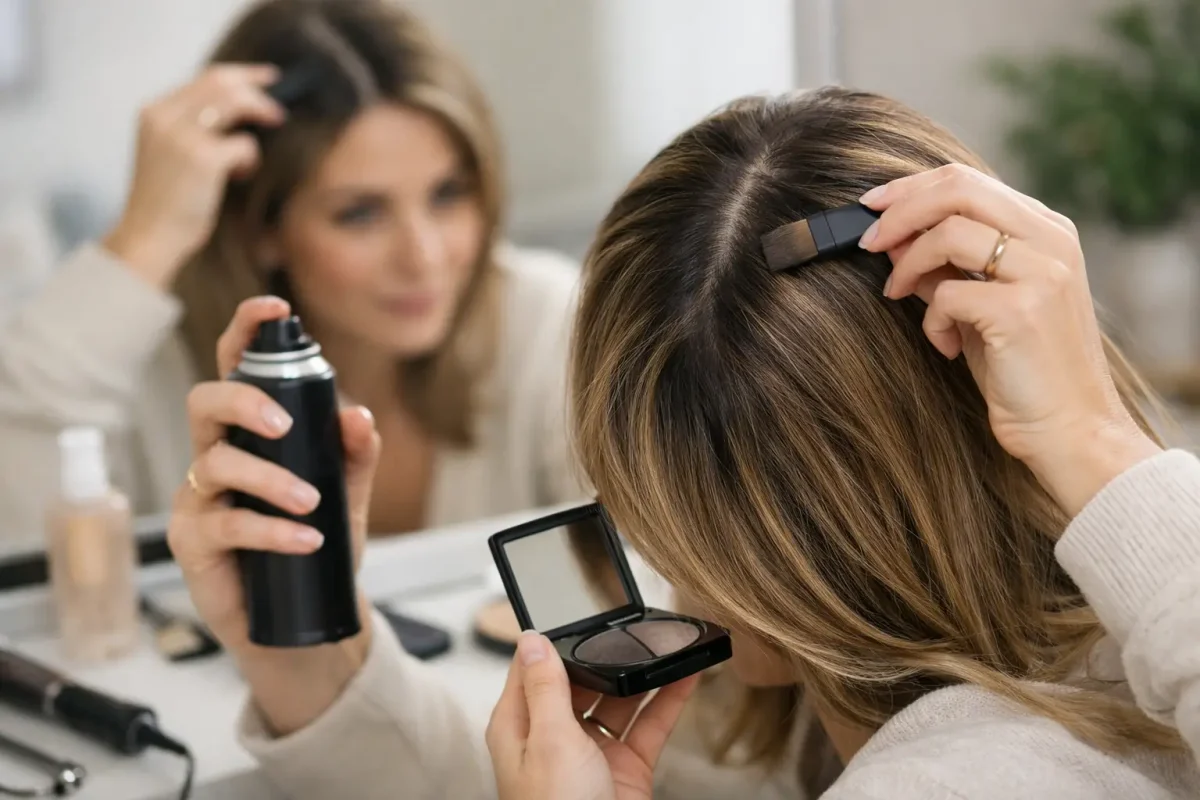
Temporary root coverage products are some of the best ways to hide regrowth when you need a fast fix for work, dinner, photos, or an event. Sprays, powders, and crayons can all help, but the right one depends on your hair type and how precise you need the coverage to be.
Sprays are usually the quickest option and work well for broader areas along the part or crown. Powders give you more control and often look softer around the hairline. Sticks and crayons can be handy for small targeted areas, but they can feel heavier on fine hair.
The trick is color matching. Going too dark creates a dull patch that looks flat. Going too warm can make the root area look brassy. A light hand always gives a better result than trying to completely paint over everything at once. Build coverage gradually, then brush through lightly if the product allows it.
It also helps to remember that temporary products are exactly that – temporary. They are great for stretching appointments, not replacing professional color long term. Overapplying them day after day can leave buildup on the scalp and make the root area feel sticky or look overly matte.
Accessories can hide regrowth without looking like a cover-up
If you want a low-effort option, accessories can work brilliantly. A wide headband, scarf, claw clip style, or strategically placed sunglasses on the head can help disguise the most visible areas at the hairline and part. The key is making it feel intentional rather than like you’re hiding from your roots.
This is where your haircut and personal style matter. If you already suit polished, pulled-back looks, a sleek low bun with a headband can look chic. If your style leans softer and more relaxed, a textured half-up style with face-framing pieces can break up the root area without feeling too done.
Not every accessory works for every regrowth pattern, though. If your roots are most obvious through the crown, a slim headband may not do much. In that case, volume and texture at the top will help more than decoration alone.
Strategic styling can buy you another week
Sometimes the answer is not covering the regrowth but styling around it. Braids, twists, half-up styles, and loose updos can shift attention away from the scalp and toward shape, detail, and movement. Even a simple blow-dry with lift at the roots can soften how visible the regrowth looks.
A messy ponytail with crown volume is often better than a tight, flat ponytail. Soft waves pinned away from the face can make the hairline less exposed. If you wear a fringe or face-framing layers, styling those sections forward can also help break up the contrast around the front.
This is also why lived-in color techniques stay popular. Balayage, root smudges, and softer blended color lines generally grow out more gracefully than blunt single-process color. If regrowth always bothers you quickly, it may be worth adjusting your color strategy at your next appointment instead of only looking for short-term fixes.
Dry shampoo can help, but only if you use it properly
Dry shampoo is often recommended for roots, and for good reason. It adds lift, softens oiliness, and can create a slightly diffused look at the scalp that makes regrowth less obvious. On blonde and lighter brunettes, it can be especially helpful because the powdery finish lightly mutes contrast.
But this is one of those it-depends tools. On darker hair, the wrong dry shampoo can leave a pale cast that makes the root area look worse, not better. Too much product can also separate the hair at the scalp, which highlights the part instead of disguising it.
Use a small amount, focus on lift rather than saturation, and brush it through. If your scalp feels coated, you have probably used more than you need.
What not to do when you’re trying to hide regrowth
The biggest mistake is reaching for box dye just to get through another couple of weeks. It feels convenient in the moment, but overlapping color onto previously lightened hair, choosing the wrong undertone, or creating uneven bands can turn a simple root refresh into a larger correction.
Another common mistake is making your styling too severe. A very sharp center part, super-flat straightening, or tightly scraped-back hair will put every bit of regrowth on display. And while repeated root camouflage products can help short term, they are not a substitute for healthy scalp care and proper color maintenance.
If you are dealing with vivid shades, silver, platinum, or high-contrast blonde, be realistic with timing. Some colors simply show regrowth faster, and no hack will make them completely invisible for long stretches. In those cases, the best result often comes from combining camouflage with a smart maintenance plan.
When a salon refresh makes more sense
If your roots are more than a quick touch-up issue, or the regrowth line is uneven, patchy, or paired with fading through the lengths, a professional appointment will save you time and frustration. Sometimes what looks like simple regrowth is actually a mix of root growth, tonal shift, and dryness through the ends, which needs a more tailored fix.
A good color plan should work with your lifestyle, not against it. If you want lower-maintenance hair, there are ways to soften future regrowth so it does not feel urgent so quickly. That might mean adjusting your shade, adding dimension, blending the root area, or choosing a color placement that grows out more naturally.
Regrowth never feels glamorous, but it is manageable when you use the right fix for your hair instead of the fastest one on the shelf. If you’d like expert help with color maintenance or a more low-maintenance color plan, book an appointment at Twisted Scissors in Bridgeman Downs.