
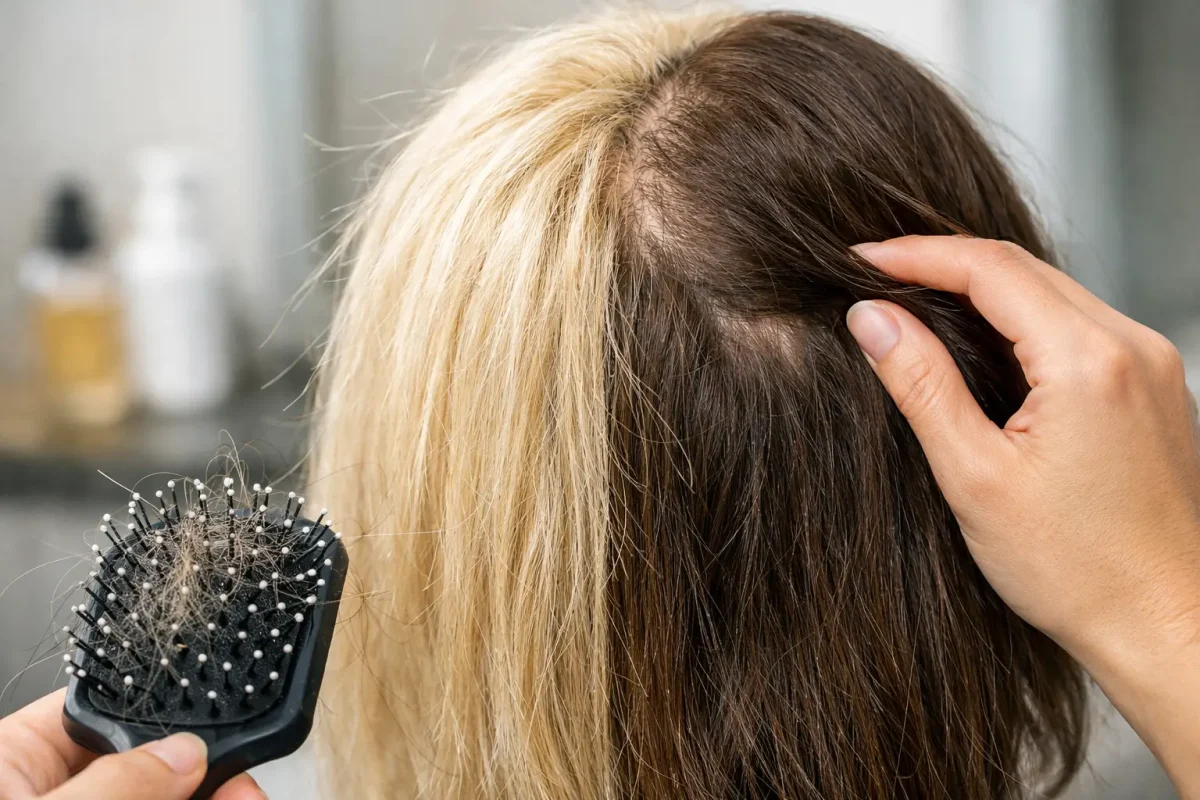
You notice it first in the shower. Then on your brush. Then in the way your ends suddenly look thinner after a lightening session. Hair loss from bleach can feel alarming, especially when you were aiming for brighter, fresher color and ended up with hair that feels fragile instead.
The first thing to know is that “hair loss” after bleaching is not always true shedding from the root. Very often, it is breakage. That difference matters, because the cause, the fix, and the urgency are not the same. Bleach can absolutely weaken hair enough that it snaps off, and in some cases it can also irritate or damage the scalp in a way that affects hair at the root.
Hair loss from bleach or breakage from bleach?
Bleach works by opening the hair cuticle and breaking down natural pigment. That process is effective, but it is also aggressive. The more lift you ask for, the more stress you place on the hair fiber.
When hair has been overprocessed, it loses protein structure, moisture balance, and elasticity. Instead of stretching slightly and returning to shape, it feels rough, gummy when wet, or dry and straw-like when dry. At that point, the hair may not fall from the scalp – it may simply break somewhere along the shaft.
A quick way to tell the difference is to look at the strands you are losing. If you see a small white bulb at one end, that is usually shed hair from the root. If the strands are shorter, uneven, or have no bulb, breakage is more likely. Many people use the phrase hair loss from bleach when what they are really seeing is chemical breakage.
Why bleach can make hair so fragile
Not all bleaching goes wrong, but every bleach service involves controlled damage. Healthy hair can often tolerate it well when the formula, timing, and aftercare are right. Problems start when the hair is already compromised or the lightening process is pushed too far.
Repeated blonding, overlapping bleach onto previously lightened sections, using developer that is too strong, or trying to jump several levels lighter in one session all increase the risk. So does using heat on freshly bleached hair, especially flat irons and curling tools at high temperatures.
Hair history matters too. If your hair has box dye, permanent color buildup, old highlights, relaxers, keratin treatments, or frequent hot tool use, bleach has less margin for error. Even naturally fine hair can be more vulnerable because there is simply less structure there to begin with.
When the scalp is part of the problem
The hair itself is one issue. The scalp is another. If bleach sits too long on the scalp, is mixed too strong, or triggers a chemical burn, inflammation can follow. In mild cases, you might see tenderness, redness, itching, or flaking. In more severe cases, blistering or scabbing can happen.
That kind of irritation can temporarily increase shedding. The good news is that many cases improve once the scalp heals. The less good news is that severe burns can lead to more lasting problems, which is why scalp discomfort after bleaching should never be brushed off as normal if it feels intense.
Signs your hair has been overbleached
Overbleached hair usually gives you warnings before it fully snaps. You may notice that it tangles much more easily, dries out fast, and looks dull no matter what styling product you use. Wet hair may stretch too much or feel mushy. Dry hair may feel brittle and break when brushed.
Split ends can suddenly move higher up the hair shaft. Ponytails may look thinner. You might also see a rough, frayed halo around the crown or face-framing pieces where the hair is most exposed and processed.
These signs do not always mean all the damage happened in one appointment. Sometimes bleach reveals damage that has been building from previous color, heat styling, tight hairstyles, sun exposure, or rough detangling.
What to do right away if you suspect hair loss from bleach
The first move is simple – stop bleaching your hair again until you know what you are dealing with. Trying to correct the tone, brighten it more, or patchy-fix it at home can turn manageable damage into a major chop.
Next, be gentle with your hair for at least a few weeks. Wash less often if you can. Use lukewarm water instead of hot. Detangle carefully, starting at the ends and working upward with a wide-tooth comb or a flexible brush made for fragile hair.
Heat styling should be reduced as much as possible. If you have to use it, keep temperatures low and always use a heat protectant. Tight buns, slick ponytails, and clip-in extensions can also add stress when hair is weakened, so this is the time to keep styling soft and low tension.
If your scalp feels burned, sore, or unusually irritated, focus on getting professional advice quickly. Severe pain, open skin, blistering, or heavy shedding from the root deserves prompt attention.
Can damaged hair be repaired?
This is where expectations need to be realistic. Hair that has snapped off cannot be reattached, and bleach damage cannot be fully undone in the sense of restoring virgin hair. But damaged hair can often be strengthened, smoothed, and made much more manageable.
Think of recovery as support, not reversal. The goal is to reduce breakage, improve feel, and protect what is still healthy.
Protein-based treatments can help temporarily reinforce weakened hair, especially if it feels overly soft or stretchy. Moisture-focused masks help if the hair feels dry, rough, and hard. Most bleached hair needs both, but the balance matters. Too much protein can make some hair feel stiff. Too much moisture without structure can leave it limp and weak.
A trim also makes a real difference. It will not solve internal damage, but removing split, fraying ends prevents those weak points from traveling upward and makes the hair look instantly fuller.
What recovery usually looks like
In the early stage, the aim is damage control. Gentle cleansing, strategic conditioning, less heat, and fewer chemical services are the priority. After that, your stylist may recommend a gradual plan that includes trims, bond-supporting treatments, glosses instead of permanent color, or spacing out future lightening appointments.
This is where professional guidance matters. Hair that looks similar on the surface can behave very differently depending on porosity, natural texture, previous color history, and how much overlap occurred during bleaching.
How to prevent hair loss from bleach next time
Prevention is almost always easier than recovery. If you want blonde, balayage, fashion shades, or a brighter refresh, the safest approach is to respect what your hair can realistically handle in one appointment.
A slower lift is often the smarter lift. Reaching your goal over multiple sessions may not sound as exciting as a dramatic same-day change, but it usually protects both the look and the condition of your hair.
Clear communication helps too. Tell your stylist about everything on your hair, even if it was months ago or you think it has mostly grown out. Old box dye, toner, henna, smoothing treatments, and at-home lighteners all affect how bleach behaves.
At-home bleaching is where many of the biggest problems start. It is not just about picking the wrong shade. It is about sectioning, saturation, timing, developer strength, scalp safety, and knowing when not to keep going. Hair rarely gets into serious trouble because bleach exists. It gets into trouble when bleach is pushed past the point of safety.
When to see a stylist instead of waiting it out
If your hair feels stretchy and mushy when wet, breaks off with very little tension, or has obvious uneven patches of snapping, book a professional assessment sooner rather than later. The same goes for scalp pain, redness, or shedding that seems to be coming from the root rather than the mid-lengths.
Sometimes the best plan is surprisingly simple – trim the damage, stop lightening, and rebuild gradually. Other times, a color correction strategy is needed to blend fragile areas and buy your hair time to recover without feeling like you have to hide it.
The encouraging part is that not every bleach problem ends in a drastic haircut. A lot depends on how quickly you stop the cycle, how honest the hair history is, and whether the next steps are based on the condition of your hair instead of the color goal alone.
Healthy lightening is possible, but it is never just about getting pale enough. It is about preserving strength, movement, and softness so the color actually looks good once you leave the chair. If your hair is showing signs of stress after bleaching, book an appointment at Twisted Scissors in Bridgeman Downs.