
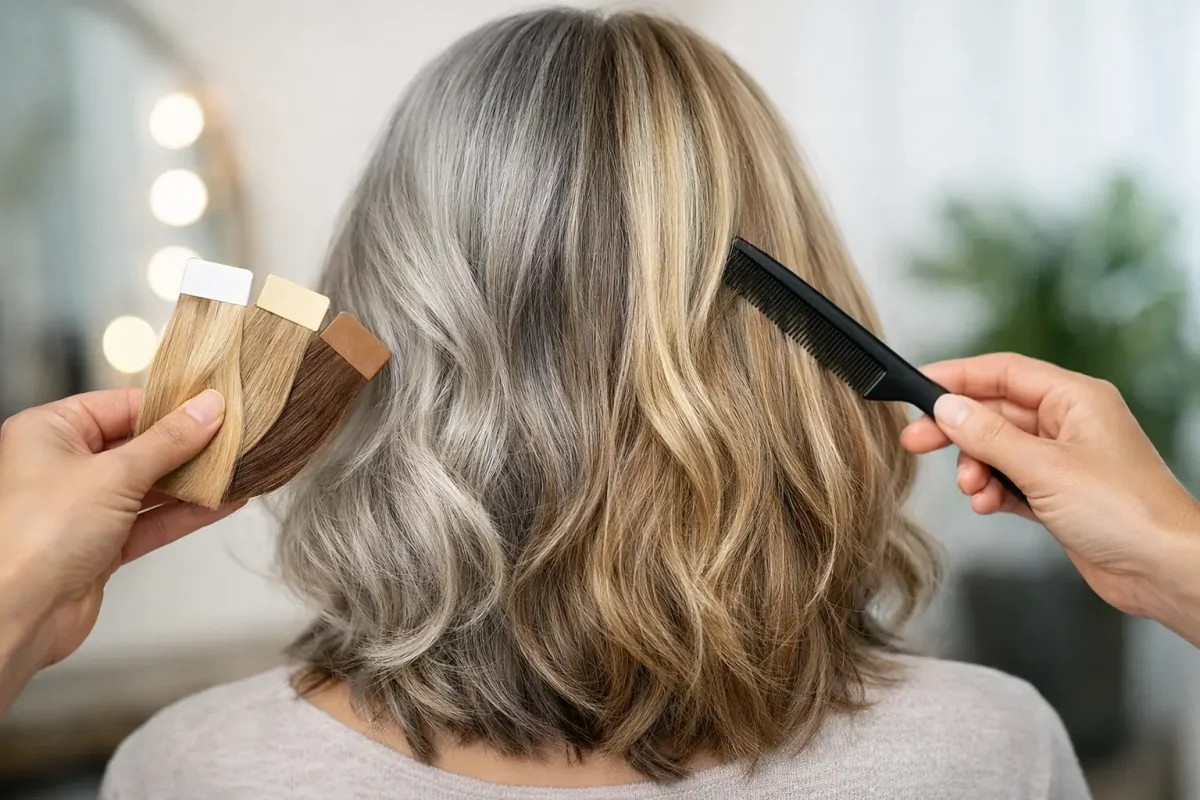
The best colours for grey blending are not always the lightest, the coolest, or the trendiest. They are the shades that work with your natural base, your percentage of gray, and how much upkeep you actually want. That is why one client looks polished with beige blonde ribbons, while another gets a softer, more flattering result from smoky brunette dimension.
Grey blending is less about covering every silver strand and more about making the regrowth line less obvious. Done well, it gives you a softer grow-out, a more natural finish, and far less of that harsh root line that comes with solid all-over color. For many women, that balance is exactly the goal.
What grey blending really means
Grey blending uses highlights, lowlights, toners, and strategically placed color to merge gray hair into the rest of your shade. Instead of trying to hide every gray completely, the idea is to make the contrast less noticeable so your color grows out more gracefully.
This approach works especially well if you are starting to see scattered grays, a bright silver hairline, or patches around the part and temples. It can also be a smart option if you are tired of frequent root touch-ups and want something that looks softer between appointments.
The right formula depends on more than just whether you usually think of yourself as blonde or brunette. Skin tone matters. Natural depth matters. The texture and porosity of gray hair matter too, because gray can be stubborn, coarse, or quick to grab tone in unexpected ways.
Best colours for grey blending by hair family
Blonde shades for a softer transition
Blonde is often the first direction people think of for gray blending, and for good reason. Lighter shades naturally reduce contrast between white or silver strands and the rest of the hair. But not every blonde works the same way.
Beige blonde is one of the most forgiving options. It sits between warm and cool, which makes it flattering on a wide range of complexions and less likely to look too icy or too golden. It also blends beautifully with natural gray, especially when paired with a shadow root or soft lowlights.
Champagne blonde can be a great choice if you want brightness without the flatness that sometimes comes from going too ashy. It has enough softness to look natural, and enough lightness to make gray feel intentional rather than accidental.
Ash blonde can work, but it is not always the easiest answer. On some hair, especially porous or very white hair, it can read dull or slightly muddy if the tone is pushed too far. Cool tones are useful, but there still needs to be shine and dimension.
If your natural color is medium to dark, going fully blonde just to blend gray is usually more maintenance than most people want. In that case, blonde highlights woven through a darker base often give a better result than trying to lift everything lighter.
Brunette shades that keep depth without harshness
Brunette can absolutely be one of the best colours for grey blending, especially when it is done with dimension. The mistake is choosing a solid dark shade that creates a sharp line against incoming gray. That is what tends to make roots stand out faster.
Mushroom brown is a favorite for a reason. It is soft, muted, and cool without looking flat. It works well when you want a modern brunette result that sits naturally next to silver strands.
Light brown and dark blonde shades are also excellent middle-ground options. If you have naturally brown hair and do not want to feel washed out by going too light, these in-between tones can make gray look more diffused. They soften contrast while still keeping your overall color identity intact.
Chocolate brown can work too, but usually with some finer highlights or face-framing brightness. On its own, a rich deep brunette may look beautiful on fresh color day, then feel a bit more obvious as gray regrowth starts to show.
Red, copper, and warm tones
Warm shades are often overlooked in gray blending, but they can be incredibly flattering. Soft copper, golden brunette, and warm caramel can add life back into hair that has started to look dull or flat from a mix of fading pigment and incoming gray.
The trade-off is maintenance. Reds and coppers tend to fade faster than blondes and brunettes, so they need more refreshing. They can still be a smart choice if warmth suits your skin and you are happy to maintain the tone.
For many women, the most wearable version is not a full copper transformation. It is a brunette or dark blonde base with warm caramel ribbons or subtle golden movement through the mid-lengths and ends. That gives softness and glow without locking you into constant upkeep.
The most flattering shades depend on your natural base
If your natural hair is dark brown, the best result usually comes from softening the base rather than fighting it. A mix of cool light brown, mushroom tones, or fine caramel and beige highlights can break up the contrast and make gray look intentional.
If your natural hair is medium brown, you have a lot of flexibility. This is often the easiest base for grey blending because it can move lighter or slightly cooler without looking unnatural. Bronde, sandy beige, and taupe-toned brunettes tend to work especially well.
If your natural hair is dark blonde or blonde, blending gray is often about refining tone rather than changing direction. Beige, pearl, champagne, or soft neutral blondes can make the silver strands disappear into the overall color pattern.
If you already have a high percentage of white or silver, trying to cover everything with a dense, dark formula can feel like a losing battle. In many cases, embracing a lighter, dimensional palette gives a fresher and much lower-maintenance result.
Placement matters as much as shade
Even the perfect color can look off if the placement is too heavy or too uniform. Grey blending works best when the lighter and deeper pieces are placed to mimic natural variation.
Around the face and part line is where most women notice gray first, so that area usually needs the most thoughtful work. Brightness through the hairline can soften those silvers and make regrowth less obvious. Through the crown and back, a blend of ribbons and depth helps keep the result from looking stripey or flat.
This is why balayage, fine foils, baby lights, and lowlights are often part of the conversation. They create movement. Solid block color rarely gives the same forgiving grow-out.
Cool tones versus warm tones
There is no universal winner here. Cool tones are popular because they sit nicely beside silver and white hair, but they are not automatically more flattering. Sometimes a very cool result can make the skin look tired, especially if your complexion naturally suits warmth.
Warm tones can make the hair look shinier and the overall result more vibrant. The risk is going too golden or brassy, especially if the underlying lift is strong. That is where toning and proper formulation matter.
Neutral shades are often the sweet spot. They give enough softness to blend the gray, enough polish to look intentional, and enough balance to avoid pulling too icy or too warm.
When grey blending may not be the best option
Grey blending is ideal for a softer look, but it is not right for everyone. If you want full, opaque coverage with no visible gray at all, blending may feel too sheer. It is also less straightforward if you have very dark previously dyed hair and want a dramatic shift without warmth coming through.
Hair condition matters too. If your hair is compromised, overly porous, or uneven from home coloring, the first priority may be correcting the canvas before aiming for your dream blend. Healthy hair simply takes and reflects color better.
How to keep blended gray hair looking fresh
Once your color is in a good place, maintenance becomes much easier than traditional root coverage, but not completely hands-off. Purple shampoo is useful for some blondes and cool brunettes, though overusing it can make the hair look dull. Color-safe products, heat protection, and regular glossing help preserve tone and shine.
The biggest advantage is that you are not racing back to the salon every few weeks just because your roots appeared. A well-planned blend tends to fade and grow out in a much softer way.
If you are starting to see silver and wondering what actually suits you, the best colours for grey blending are the ones that make your regrowth less obvious, your complexion brighter, and your routine easier to manage. If you want help choosing the right blend for your hair, book an appointment at Twisted Scissors in Bridgeman Downs.
[…] the placement is good, a gloss may be enough to refine the finish. If there are distinct stripes, fine lowlights or a root shadow can soften the contrast and rebuild dimension. If the hair has dark patches or […]