
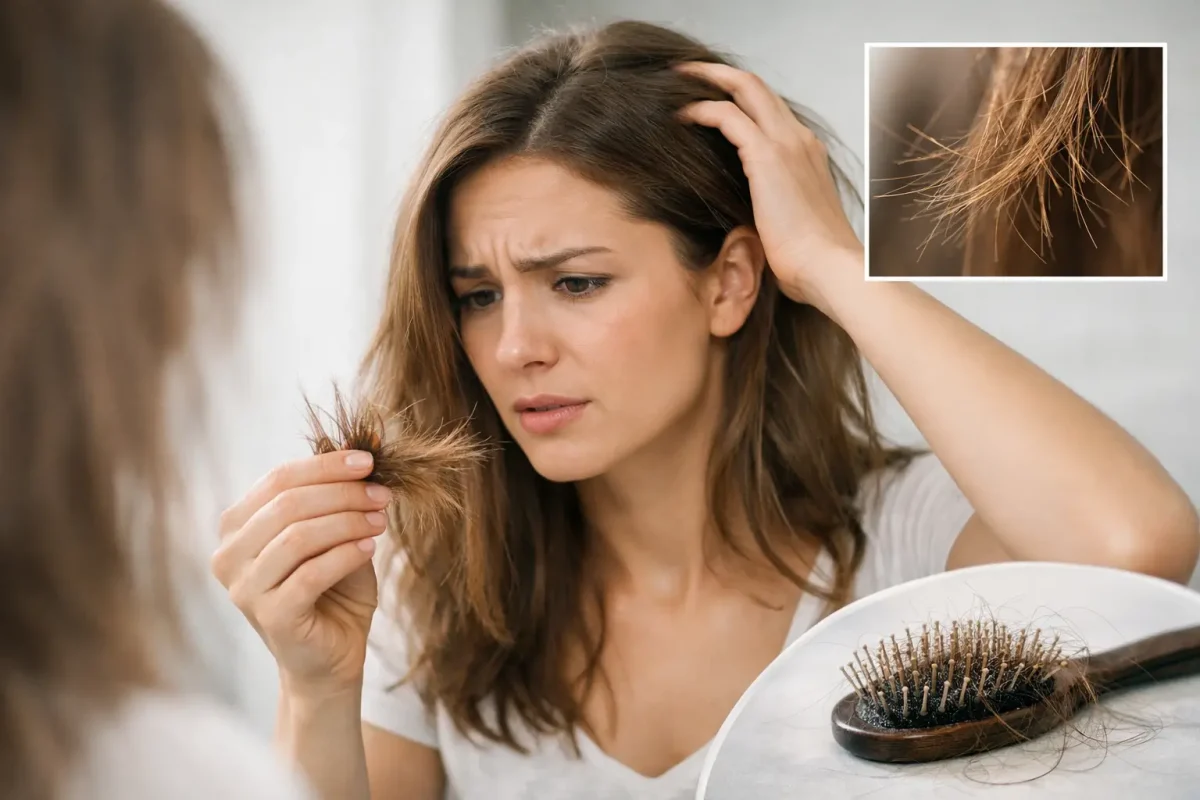
You usually notice it while styling. Your ends will not sit right, your shine seems to have disappeared, or your hair starts snapping when you brush it. The tricky part is that signs of damaged hair do not always show up all at once. Sometimes the change is gradual, especially if heat styling, lightening, or even sun exposure has been part of your routine for a while.
Healthy hair does not need to be perfect. A little frizz, some texture, or the occasional split end can be completely normal. Damage becomes the bigger issue when your hair starts feeling harder to manage, less elastic, and noticeably weaker than it used to be. If your hair has stopped behaving like your hair, it is worth paying attention.
What damaged hair actually looks like
Hair damage is usually a mix of surface wear and deeper structural stress. The outer layer of the hair shaft, called the cuticle, can become raised, chipped, or worn down. When that happens, moisture escapes more easily, shine drops off, and the inner structure is left more vulnerable.
That damage can come from repeated bleaching, high heat, harsh brushing, tight hairstyles, chemical processing, or a routine that is simply not matching your hair type anymore. It is not always about one dramatic mistake. More often, it is the result of small habits adding up.
The most common signs of damaged hair
1. Split ends that keep coming back
A few split ends are common, especially if it has been a while between trims. But if your ends look feathery, frayed, or forked soon after a haircut, that is a different story. It usually means the hair is dry and weakened enough to keep splitting upward.
Once an end is split, no product truly fuses it back together long term. Serums can smooth the appearance, but the damaged section still needs to be trimmed away before it travels further.
2. Hair that feels rough instead of smooth
One of the clearest texture changes is that damaged hair starts to feel coarse, squeaky, or uneven from mid-length to ends. You might notice it tangles more easily in the shower or feels straw-like when dry.
That roughness often points to a disrupted cuticle. Smooth hair reflects light better and slips past itself more easily. When the cuticle is compromised, the hair feels less polished and more resistant to styling.
3. Breakage around the crown or hairline
Breakage is different from shedding. Shedding happens at the root and you will see a full strand with the bulb attached. Breakage happens along the shaft, so the pieces are shorter and often show up around the crown, front hairline, or wherever the hair experiences the most heat and tension.
If you are seeing short snapped-off bits that stick up no matter what you do, damage is likely part of the picture. Tight ponytails, frequent flat ironing, and aggressive brushing are common causes.
4. Ends that look thinner than the rest of your hair
If your hair feels full near the roots but wispy or transparent at the ends, it can be a sign that damage has worn away the length. This is especially common with overprocessed blonde hair or hair that has gone too long without a trim.
You do not always need a dramatic cut, but you may need more than a dusting. Holding onto damaged length often makes the whole style look less healthy, even if the top half of your hair is in good condition.
5. Hair that stretches too much when wet
Healthy hair has some elasticity. It should stretch slightly and return to shape. Damaged hair often stretches too far when wet and then snaps instead of bouncing back.
This kind of weakness can show up after chemical lightening or repeated heat styling. If your wet hair feels gummy, overly stretchy, or mushy, treat it gently. That is not the time for rough towel drying or pulling a brush through from root to end.
6. Dullness and missing shine
Shine is not just about products. It is largely about how smooth the cuticle is. When hair is damaged, light does not reflect evenly, so even freshly washed hair can look flat.
This is one of the most frustrating signs because people often respond by adding more product. Sometimes that helps cosmetically, but if the surface of the hair is worn down, the real fix is a healthier routine and possibly cutting off the worst of the damage.
7. Constant tangling
Hair that knots easily, especially underneath or at the ends, often has cuticle damage. Raised or roughened cuticles catch on neighboring strands and create those stubborn tangles that seem to form out of nowhere.
If your hair never used to tangle and now does every day, pay attention to what changed. New color services, more hot tools, or even sleeping with wet hair can all make tangling worse.
8. Frizz that does not match the weather
Humidity can make almost any hair type frizz. But when frizz is constant, even on mild days or right after styling, damage may be the reason. Porous hair pulls in moisture from the air unevenly, which makes the surface swell and lose shape.
This is where people sometimes confuse natural texture with damage. Curly, wavy, and textured hair can naturally have halo frizz. The difference is that damaged frizz usually comes with dryness, dullness, and breakage as well.
9. Color that fades too fast
If your salon color starts washing out unusually quickly, porous hair may be to blame. Damaged hair struggles to hold onto pigment because the cuticle is not sealing properly.
This matters whether you wear soft brunette tones, bright copper, or something more playful like pastel or vivid shades. Fashion colors in particular need healthy hair underneath them to look their best and last well.
10. Styling that no longer lasts
When hair is damaged, it can become unpredictable. Curls drop fast, smooth blowouts puff up, and styles that once held with little effort seem to fall apart in an hour.
That is partly because weakened hair does not respond consistently to heat and tension. It can also be a sign that your current cut is fighting against compromised ends.
When damage is mild and when it is more serious
Not all damage needs a major reset. Mild damage might look like a bit of dryness, slight fading, or ends that need cleaning up. In that case, a trim, less heat, and better home care can make a visible difference fairly quickly.
More serious damage tends to feel obvious. The hair may break easily, look uneven through the mid-lengths, feel mushy when wet, or refuse to hold color and shape. That is when trying to fix everything with masks alone usually falls short. Hair can be improved, but some sections may need to be cut away so healthier growth has a chance to take over.
What to do if you notice signs of damaged hair
Start with the basics. Reduce heat where you can, and if you use hot tools, lower the temperature and apply heat protection every time. Be gentler when your hair is wet, because that is when it is most vulnerable.
It also helps to rethink your wash and styling habits. A moisturizing shampoo and conditioner can support dry hair, but very damaged hair often benefits from a balanced routine that includes both moisture and protein. Too much of either can backfire, so this is one of those areas where it depends on your hair’s condition, texture, and chemical history.
If your damage is linked to color or lightening, professional advice matters. A stylist can tell you whether your hair is ready for another service, whether it needs a break, or whether a gloss, toner, trim, or treatment would make a bigger difference than pushing ahead with more processing.
Signs of damaged hair are easier to treat early
The sooner you catch damage, the more options you usually have. Waiting until your ends are splitting halfway up the strand or your hair is snapping around the crown limits what can be repaired cosmetically. Early action gives you more room to keep your length, improve manageability, and protect future color results.
If your hair feels off, trust that instinct. The best results usually come from small corrections made early, not dramatic rescue attempts later. If you want a professional opinion on your hair’s condition and the best next step, book an appointment at Twisted Scissors in Bridgeman Downs.